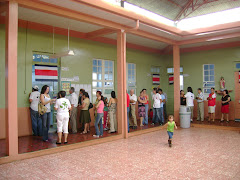
10/11/2007

Press Release about Irregularities during Referendum

Below you can read the official press release of the center that collected complaints over irregularities in the referendum. They are part of the Association for Human Rights in Costa Rica. Among the gravest complaints is, of course, the violation of the media blackout, especially by the Arias-owned TV station Repretel, which broadcast PUSC deputies asking people to vote YES on Friday. Other complaints focus on companies pressuring employees to vote yes. One company which exports plants and flowers to the US supposedly told its employees that they need not come to work on Monday of the NO wins, implying that the company would have to shut down in that case. Companies are claimed to have offered their employees money for a yes vote, collective breakfasts ad rides to the polling stations, est.Most complaints deal with event at the polling places, involving incorrect administration, intimidation, and the distribution of propaganda in spite of the prohibition.

COMUNICADO INTERNACIONAL DE PRENSA
CENTRO CIUDADANO PARA LA RECEPCIÓN DE DENUNCIAS
SOBRE EL REFERENDO DEL TLC


Los principales dirigentes del Movimiento Patriótico contra el TLC, decidieron la noche de ayer (07 de Octubre de 2007) no aceptar la victoria del Sí en el referéndum sobre el TLC, hasta tanto no se reúnan con los distintos comités patrióticos que estuvieron trabajando intensamente durante la campaña.

El objetivo de dicha reunión, será decidir las acciones a tomar frente a los resultados arrojados hasta el momento por el Tribunal Supremo de Elecciones (TSE), los cuales dan a los partidarios del TLC una escasa ventaja de tres puntos porcentuales sobre los opositores.

Lo anterior, a raíz de la gravedad y cantidad de denuncias sobre irregularidades en el proceso de referéndum, que durante los dos últimos días fueron presentadas al Movimiento Patriótico.

Es sobre este último punto, sobre el que queremos aportar algunos elementos.

Quienes participamos de este Centro Ciudadano de Denuncias, somos testigos de la gran cantidad de quejas presentadas contra los partidarios del TLC, a raíz de sus evidentes violaciones de la legislación electoral vigente. Muchas de estas denuncias, consideradas sumamente graves en tanto atentan directamente contra la institucionalidad democrática y la pureza y transparencia del proceso.

Entre los hechos denunciados de mayor gravedad, se encuentra el de que los partidarios del TLC continuaron distribuyendo propaganda, organizando concentraciones planificadas y pautando gran cantidad de anuncios en las televisoras nacionales a dos días del referéndum, pese a que el Código Electoral, en su artículo 85, inciso g), establece claramente que "Durante los días inmediatos anteriores y el día de referéndum no podrá difundirse propaganda de ninguna especie relativa al proyecto objeto de consulta", disposición que los opositores al TLC si acataron estrictamente.

Incluso, el propio TSE en su Sesión Extraordinaria Nº 94-2007, ya había hecho la advertencia de que "durante los dos días inmediatos anteriores y el día del referéndum, NO PODRÁ DIFUNDIRSE PROPAGANDA DE NINGUNA ESPECIE, relativa al proyecto objeto de consulta, lo que incluye la repartición de volantes, panfletos, utilización de altoparlantes o de cualquier medio tendiente a influir en la decisión de voto."

Como ejemplo concreto de esta violación podemos mencionar que gran cantidad de personas denunciaron que el día 05 de Octubre de 2007, la empresa REPRETEL canal 4, pautó publicidad en donde aparecían Diputados del Partido Unidad Social Cristina (PUSC) invitando a la población a votar por el Sí.

Claramente, los medios nacionales de comunicación se convirtieron en canales abiertos para que el gobierno de Oscar Arias y los promotores del tratado, distribuyeran unilateralmente su propaganda; tal como sucedió con la amplia cobertura que los medios noticiosos nacionales dieron a las declaraciones de Susan Schwab, Representante de Comercio Exterior de Estados Unidos, en donde afirmaba categóricamente la imposibilidad de renegociar el tratado, así como la posibilidad de perder los beneficios de la Iniciativa para la Cuenca del Caribe, si los costarricenses votaban negativamente en el referéndum.

Todo lo anterior sin que el TSE, órgano encargado de la vigilancia y organización del referéndum, se dignara realizar acciones para evitar la continuación de estas violaciones. Actitud que ha generado gran indignación entre los costarricenses, quienes señalan a dicho tribunal como corresponsable de los abusos mencionados.

Presentamos a continuación un resumen de las denuncias recibidas, aclarando que estas constituyen solo una muestra de la totalidad, ya que en el país fueron instalados gran cantidad de centros para la recepción de denuncias que trabajaron de manera independiente.

1. En la Escuela de Cañas Dulces de Liberia, partidarios del Sí distribuyeron y pegaron propaganda favorable al TLC dentro del Centro de Votación. Dos niñas que se acercaron a solicitarles a estos partidarios del Sí que no siguieran repartiendo propaganda dentro del centro de votación, fueron amenazadas de palabra por dichas personas. También informan que la directora de la Escuela, que es delegada del TSE, amenazo con golpear a una señora que le solicito intervenir en el asunto.

2. En la Escuela de Esquipulas de Palmares, dos dirigentes del Sí, con una actitud sumamente agresiva, que no quisieron identificarse, se dedicaron a agredir verbalmente a cualquier partidario del No que ingrese a votar al centro de votación. También denunciron que a los menores de edad con camisetas del No, no los están dejando ingresar para cumplir con su trabajo como guías, al centro de votación, aduciendo que los menores de edad tienen restringido el acceso a dicho lugar. Sin embargo los menores de edad guías del Sí están ingresando libremente al centro de votación.

3. En Cariari de Pococí, se tramitaron 76 acreditaciones para fiscales del NO pero el TSE solo se entregó 14 credenciales del total solicitado.

4. Miles de personas denuncian que el día 05 de Octubre de 2007, la empresa REPRETEL canal 4, se encuentra pautó publicidad favorable al Sí al TLC

5. Denuncian el envío masivo de mensajes de vos a su celular promoviendo el Sí al TLC, así como de mensajes de texto que dicen: "Yo creía que el TLC no me afectaba. Pero Ana se va a quedar sin trabajo. Ayudemos. Vota
Sí".

6. Varias personas denuncian coacción por parte de distintas empresas sobre sus empleadas y empleados. Estas personas prefirieron permanecer en el anonimato por temor a posibles represalias de parte de sus patronos. Entre las empresas denunciadas están la empresa Del Oro, productora de concentrado de jugo de naranja en la zona de Guanacaste y diversas empresas del Parque Industrial de Cartago, Desamparados y empresa piñeras de Pocorá de Guápiles, las cuales han "invitado" a sus empleados a un almuerzo familiar el domingo 07 de octubre, con transporte incluido y luego de acudir a las urnas a votar por el Sí.

7. También, nos informan que varias empresas de la zona de Poasito de Alajuela dedicadas a la exportación de flores y follaje, advirtieron a sus empleadas y empleados, que en caso de que ganará el NO en el referendo del domingo, ya no era necesario que llegaran el lunes a laborar.

8. Desde Turrialba nos llaman denunciando que los partidarios del Sí están llamando a la gente a "participar" a cambio de 30.000 colones.

9. Desde Los Guidos denuncian que en la escuela de la localidad el Movimiento Libertario aparentemente permitió la alteración de uno de sus fiscales, siendo este sustituido por una persona de nacionalidad
nicaragüense.

10. Desde Bribri de Talamanca nos informan que en el acto de apertura del centro de votación, efectivos del Ministerio de Seguridad, equipados con armas de grueso calibre, registraron completamente los recintos electorales. Posteriormente y más grave aún, estos mismos policías se apostaron en la entrada de cada recinto electoral portando aún sus armas de grueso calibre. A las 9:30 de la mañana los uniformados se mantenían a la entrada de cada recinto electoral. Dichas actuaciones son interpretadas por la población partidaria del NO como un acto de intimidación.

11. Desde el Liceo de Paraíso de Cartago, denuncia que una señorita guía del No fue agredida por un
partidario del Sí, el cual argumentó que ella portaba una camiseta del No al TLC sobre el pecho, lo cual constituía una grave ofensa para él.


12. En la Escuela de Concepción Abajo de Alajuelita, un partidario del No fue agredido por partidarios del Sí, los cuales le causaron una herida profunda en la ceja. Delegados del TSE fueron testigos de los hechos.
13. En la Escuela Carmen Lyra, de Concepción Arriba de Alajuelita, niñas y niños que se encuentran
trabajando como guías del No están siendo acosados por los partidarios del Sí. Se ha solicitado la intervención de la Fuerza Pública, pero esta se ha negado a intervenir en el asunto.


14. Gran cantidad de denuncias relacionadas con el uso en forma indistinta de lapiceros negros y rojos para votar y llenar el material electoral, esto a pesar de que el mismo TSE había dispuesto que sólo se iban a permitir los votos emitidos en tinta negra, mientras que en las mesas en donde los funcionarios del TSE tramitarían la papelería solamente se permitiría la utilización de tinta roja. Esta normativa, la cual tenía por objetivo evitar la posibilidad de fraude, nunca se respetó, y a pesar de la gran cantidad de denuncias recibidas al respecto, el TSE nunca aclaró públicamente si los votos emitidos en rojo se tomarían como válidos, o que pasaba con las mesas en los que los miembros del tribunal utilizaron ambos colores indistintamente.

15. En Tejar del Guarco una de las juntas de votación cerró 5 minutos antes de las 6:00 pm.

16. En la junta electoral 2171 de Palmares, cerró cinco minutos después de las 6:00 pm. con el objeto de permitir la votación de dos fiscales del Sí. Esto, a pesar de que las demás juntas electorales ya habían cerrado y además, dejando fuera del recinto a dos fiscales favorables al No que estaban monitoreando la junta.

17. El Partido Acción Ciudadana denuncia que el Alcalde de Guápiles, acompañado de partidarios del Sí, ingresaron al puesto de guías del bando del No en Guápiles, golpeando a las personas presentes y destruyendo inclusive una computadora del lugar.

Todas estas denuncias son del conocimiento del Tribunal Supremo de Elecciones.


Centro Ciudadano para la Recepción de Denuncias sobre el Referendo del TLC
Colectivo Comunidades
Asociación Costarricense de Derechos Humanos
Lunes 08 de Octubre de 2007.-

10/09/2007

SI wins the Referendum

The official results of the referendum are 51.6 for and 48.4 against the CAFTA. The breakdown by provinces are the following:

San Jose: SI 51.7 NO 48.3

Heredia: SI 52.4 NO 47.6

Alajuela: SI 48.9 NO 51

Guanacaste: SI 47.3 NO 52.7

Puntarenas: SI 49.4 NO 50.6

Cartago: SI 56.5 NO 43.5

Limon: SI 54.9 No 45.1

The most surprising of these is no doubt San Jose, having voted overwhelmingly against president Arias and the PLN in last year’s elections and having repeatedly and decidedly appeared opposed to the CAFTA in various polls, the fact that it now voted in favor if the treaty is very strange and surprising. Guanacaste and Puntarenas were expected to come out srongly in favor of the TLC and did not. Even though the CAFTA was the most important issue in the national elections last year, votes in this referendum do not seem to have much to do with votes last year. Attempt to explain this vary widely. Some claim that there was fraud and that the organizers of the fraud, after having manipulated the rural provinces last time, decided to focus solely on San Jose this time, implying that the victory in the provinces is exemplary for what would have happened in San Jose without the fraud. Others, including some researchers of the UCR have found an interesting trend of vote reversal among the voters in Costa Rica. According to this observation, there is this strange trend of switching back and forth of the vote. So if the provinces voted for the Conservatives in one election and the central valley for the social democrats, then in the next elections it will be the central valley that votes conservative and the provinces that vote social democratic. So this could have something to do with the strange inconsistencies in votes. Others argue that the leaders of the NO spent too mauch time at their desks running the national campaign and did not do enough street work in the inner city. As more results come out, I will pick up this issue again…You can find more detailed results on the webpage of the Electoral Tribunal.

While on Sunday night, the leaders of the NO refused to concede, by Monday midday, Ottón Solís of the PAC, José Merino of the Frente Amplio, and Oscar López of the PASE accepted the results. The only grouping that is still holding out is the Movimiento Patriotico del NO al TLC under the leadership of Eugenio Trejos. Recall that this movement is based on hundreds of so-called Patriotic Committees in communities that have been organizing the local No campaigns. In an emergency meeting Monday afternoon, the Movimiento decided to have the local committees review the results their observers recorded and make a decision whether or not to accept the official results. An assembly of nation delegates will take an official vote later in the week instructing Trejos on what to do next. Some Comités have reported inconsistencies between the voted recorded by them and those reported by the TSE. More on this as it develops…

But with every single opposition politicians in the legislative assembly having accepted the victory of the CAFTA, it is hard to imagine what the movement could do now to stop the CAFTA.

Whether or not fraud was committed with the ballots, one thing is undeniable: the YES side violated the media blackout. Costa Rican law states that there is to be no campaigning and reporting on the campaigns during the last three days before an election. Several TV channels and the main newspapers did not follow the blackout order when they reported on the ongoing debate over the CBI benefits and possible expiration between US and Costa Rican officials, and comments by Bush administration officials regarding possible retaliation in case of a rejection of the CAFTA. (see La Nación of Friday, and Saturday for example). A blatant example was the coverage of the channel Repretel, owned by President Arias, of the dangers of loosing CBI benefits in case of a rejection of the TLC on Sunday morning as the the voting booths opened. Repretel interviewed representatives of the pineapple, banana, tuna, and textile industries stating variously that they will have to close down, relocate, cut back jobs, etc of the CAFTA does not go into effect.

10/05/2007

Controversy over US Retaliation Act II

Representative Linda Sanchez published a clarification regarding her interview with La Nacion yesterday. An excerpt:

“I understand that some in Costa Rica have reported that I believe the President of the United States can unilaterally withdraw Caribbean Basin Initiative (CBI) benefits that Costa Rica currently enjoys if the people of Costa Rica vote to reject the Central American Free Trade Agreement (CAFTA). This report is obviously the result of some confusion concerning my remarks.

"The fact is that under the laws of the United States, the President of the United States does not have the power to cancel CBI benefits to Costa Rica if Costa Rica rejects CAFTA. Eliminating basic CBI benefits with Costa Rica would require an act of Congress. The leaders of both the United States Senate and the United States House of Representatives have stated in a recent letter that they would not do that.

"Further, that September 28, 2007, letter from Senate Majority Leader Harry Reid and Speaker of the House Nancy Pelosi made clear that they oppose any linkage between CBI benefits and approval or disapproval of CAFTA.

"Finally, I note that the United States Trade Representative has been opining in the media about what may or may not take place following the referendum on Sunday in Costa Rica. It is important to note that she is an appointee of President Bush, who will leave office at the beginning of 2009 and is likely to be replaced by a successor who does not share his political perspective. One thing is certain. Regardless of the outcome of the referendum, Costa Rica's basic CBI benefits cannot be unilaterally taken away by the Bush Administration."


Today, three Democratic Senators (Dorgan, Bown and Sanders) sent a letter to President Bush, expressig their concern over Secratary of Commerce Susan Schwab's statements in yesterday's interview with La Nacion:

"We are particularly disturbed by her comment that "Costa Rica could lose valuable access to the US market if the country rejects a free trade agreement with the United States when its voters go to the polls on Sunday."

"As you know, this is nonsense. Barriers to access of Costa Rican goods will not change if Costa Rican voters reject CAFTA. [...] For an official of the United States to warn the people of Costa Rica of possible retaliation of any kind for exercising their rights in an election is unworthy of the democratic traditions our countries share. This is particularly disheartening since CAFTA is just as controversial in the US as it is in Costa Rica."

For now, the last chapter in this controversy for now, was written by the Chairman of the House Ways and Means Committee, Charles B. Rangel in a press release:

"“Congress is constitutionally responsible for regulating international commerce. As such, we reiterate our longstanding position that preference programs should not be conditioned on a country entering into a free trade agreement (FTA) with the United States . No U.S. preference program currently includes such conditionality. Furthermore, there is no provision in the current preference program statute that would permit the President to withdraw benefits if a beneficiary country failed to implement an FTA.”

Controversy over US Retaliation - Pelosi, the Ambassador, and the Secretary of Commerce:

The day after Congressmen Sanders and Michaud gave their press conference here, the Costa Rican ambassador to the United States, Tomás Dueñas gave an interview in La Nación, in which he accused Sanders and Michaud of not supporting development and growth in the Central American region. He then admitted that while in principle, a renegotiation of the treaty may be possible, it is very unlikely that this could take place right now with the election process and the loss of trade promotion authority by president Bush. With this he contradicted what has been the official position of the Arias government, namely that renegotiation was simply never a possibility and that it is merely a myth created by Ottón Solís. He went on to argue that Sanders and Michaud do not represent the majority in Congress and the the CBI (Caribbean Base Initiative) benefits are not secured for CR in case of NO vote on Sunday.

On Saturday, Democratic leaders Nancy Pelosi and Harry Reid wrote an open letter to ambassador Dueñas, strongly rejecting his claim that there could be CBI repercussions.

"We understand thatit has been asserted by some that there is a link between the referendum vote and Costa Rica's continued participation in the CBI. We are not aware of any connection between the two. Participation in the CBI is not conditioned on a country's decision to approve or reject a free trade agreement with the United States, and we do not support such a linkage."

But this did not seem enough to stop the controversy. The following day, La Nación quoted Republican Congressman Jim McCrery as saying that no member country of the ICC can be assured that its benefits are eternal. Undersecrataty of Commerce, John Verenau is quoted as saying that the consequences of a NO vote are uncertain. And Dueñas called the letter “vague.”

On Tuesday, La Nación again portrayed the CBI benefit as threatened. In a phone interview with democratic Congress woman Linda Sanchez, they got her to admit that the executive had in principle the power to exclude any country from the CBI. She said: “I don’t have this section in front of me right now, but the thing is that this power is based in the executive branch and I cannot guarantee that the President will not use it in whatever form he likes,” according to La Nación. She emphasized, however,that the CBI benefits do not depend on CAFTA ratification. Finally, Republican leader Roy Blunt stated in a written declaration that there is nothing that commits the US to maintaining the benefits of the ICC for any country eternally and accuses the Democrats of trying to dissuade the Costa Rican people from voting for the CAFTA.

Finally, Susan Schwab, Secretary of Commerce, gave an interview to La Nacion today, in which she repeated that certain CBI benefits (textiles and tuna) are possibly threatened, since the CBI does indeed expire next year, and the US has never confronted a situation in which an CBI partner has refused to sign a trade deal. She called a possible renegotiation unlikely. So the question arises, who is right, Sanders and Michaud, or Schwab? Both, in some way, actually.

The way I understand it, is this: The CBI itself does not expire next year. But, in 2000 the US voluntarily added tuna and textiles to the CBI benefits and gave it a preliminary validity of eight years. In response, a spokessperson for the tuna industry threatened with relocation to El Salvador in case of a rejection of CAFTA, while a spokesperson for the textile industry said he di not see a way for the industry to continue to exists after the its CBI benefits expire.


10/03/2007

NO 12% in the lead!

La Nacion just posted the results of the most recent Unimer poll regarding the referendum: The NO has 55% and the YES 43%. 1202 were interviewed between Sept. 27 and Oct.2. To read the article and view the results, go to:

http://www.nacion.com/ln_ee/2007/octubre/03/pais1263817.html

Minister of the Presidency Rodrigo Arias blamed the memorandum scandal in an interview with La Nacion this morning in a apparent change of strategy. From downplaying the scandal, the administration seems to have decided to start using it as a scapegoat.

http://www.nacion.com/ln_ee/2007/octubre/03/pais1264016.html

Over 100.000 march to close NO campaign

Last Sunday, exactly seven days before the referendum, the NO campaign held its last big demonstration in downtown San Jose. Filling the Paseo Colon and the Avenida Segunda from the Park La Sabana to the Metropolitan Cathedral. Estimates of the size of the crowd range from over 100.000 people (Reuters, La Nacion) to 150.000 (AFP), to 300.000 (Union of the ICE). With three stages, street theater, patriotic hyms and songs, food stands, porta toilets, thousands of flowers handed out to the protesters, and many children and dogs, the well-organized and absolutely peaceful event had a flair of a street festival. But that is not to underestimate the political caliber of the event.

Perhaps the most impacting speech was given by Monsiňor Ignacio Trejos, one of the three bishops that have decided to come out publicly against the TLC, against the position of their church. Refering to the words of the pope, he argued that this fight is between evil and good, the devil against god, the people of the YES against the NO, the Selfish against Solidarity, and the rich against the poor. He argued that god is always on the side of the poor, and this is why the TLC must be defeated. The three bishops had caused a big stir when they published their letter in response to the letter of the priests last week, and having Trejos, who also played a leading role in the fight against the Combo del ICE, speak at the rally made a huge impact.

The last speaker was Eugenio Trejos, the leader of the NO campaign. The theme of his speech was the execution of Juan Mora, president of the CR in 1856 and 57, who defeated the troops of William Walker the Filibuster, and who was executed after a military-oligarchy coup. The day of the march was the 147th anniversary of the day Juanito Mora, as he is called here, died. The CAFTA proponents have commonly been portrayed as the new filibusters. After a minute of silence to remember Mora, in which the entire city center seemed to stop breathing, Trejos began firing up the crowd, eventually culminating in the singing of the folksong Ha Llegado La Hora de Juanito Mora by thousands surrounding the main stage. Then Trejos began to make a series of demands for the scenario of a victory of the NO, like education and tax reform, agricultural reform, and the creation of a development bank, in reference to a statement made by president Arias the day before. The president had answered a question about a plan B in case the No wins, by saying that he did not have one, that the interviewer should go and ask the NO. Trejos did not seem to want to let that chance pass. I'll post the transcripts as soon as they are available.

Agence France Press article: http://afp.google.com/article/ALeqM5gOYugkTdPCViwF4b64e8pFNisoBA

http://www.nytimes.com/2007/10/01/world/americas/01costarica.html

Reuters: http://lta.today.reuters.com/news/newsArticle.aspx?type=topNews&storyID=2007-09-30T203044Z_01_N30247906_RTRIDST_0_INTERNACIONAL-COSTARICA-PROTESTAS-EEUU-SOL.XML

Inter Press Service: http://www.ipsnoticias.net/nota.asp?idnews=86085

La Nacion: http://www.nacion.com/ln_ee/2007/octubre/01/pais1259895.html

Diario Extra: http://www.diarioextra.com/2007/octubre/01/nacionales01.php

10/02/2007

92 Priests Come out Against the TLC

92 Catholic priests used the Episcopal conference last Wednesday to announce the publication of a 42 page letter written and signed by them criticizing the CAFTA and confirming their opposotion to the treaty. In the document entitled Valoración Ética del Tratado de Libre Comercio they argue the treaty implies a radical reform of the state leading to the imposition of a neoliberal economic model and the concomitant growth of social injustice. They criticize the secretism with which the treaty was negotiated, the lack of preparation and experience of the the negotiators, as well as their lack of professional integrity, the climate of fear and anxiety, the promises not kept, the absence of a Central American common position, and the campaign of disinformation. They then give a succinct summary of the negative consequences the treaty (it is a treaty, not and agreement - a very important legal difference) will have in their opinion in the areas of national sovereignty, intellectual property rights, agriculture, environment, social equality, respect for human life, and access to natural resources. After describing the imbalance between the winners and the losers of this treaty, they denounce the pressure that some companies are putting on their employees to vote in favor. This document avoids confronting the official Church position, according to which church officials are not to take position on the CAFTA, directly, by presenting itself as merely an ethical guideline. Archbishop Barrantes has reaffirmed the official neutrality of the Church but added that no sanctions would be applied to the priests, a request made by the minister of the presidency, Rodrigo Arias.


To read the document, go to:
http://donatien.wordpress.com/category/iglesia-catolica/